Mastering Home Organization: 6 Practical Strategies to Declutter Your Space in Under 3 Hours
Mastering Home Organization: 6 Practical Strategies to Declutter Your Space in Under 3 Hours
In our fast-paced world, the state of our living environment often mirrors the state of our minds. A cluttered home can lead to a cluttered mind, causing stress, reducing productivity, and making it difficult to relax. Conversely, a well-organized space can foster peace, enhance focus, and create a more enjoyable atmosphere. If you’ve ever felt overwhelmed by the sheer volume of your belongings or the endless task of tidying up, you’re not alone. Many people struggle with maintaining order in their homes, often because they lack effective home organization strategies. The good news is that achieving a significantly more organized home doesn’t require weeks of effort or a complete overhaul of your lifestyle. With the right approach and a few practical home organization strategies, you can make a substantial impact in just a few hours.
This comprehensive guide will walk you through six actionable home organization strategies designed to help you declutter your space efficiently and establish sustainable systems. We’ll explore techniques that not only tackle existing clutter but also prevent it from accumulating again, ensuring your efforts yield lasting results. Whether you’re looking to refresh a single room or kickstart a whole-house transformation, these strategies are adaptable and effective. Get ready to reclaim your space, reduce stress, and enjoy the profound benefits of a beautifully organized home. Let’s dive into the world of effective home organization strategies and discover how you can achieve remarkable results in under three hours.
1. The ‘One-Hour Power Purge’: Targeted Decluttering for Immediate Impact
One of the most effective home organization strategies for quick results is the ‘One-Hour Power Purge.’ This isn’t about deep cleaning or reorganizing every single item; it’s about making a significant dent in visible clutter in a short amount of time. The key is to choose one specific area that causes you the most stress or is highly visible, such as your kitchen counter, entryway, or a single overflowing drawer. Set a timer for one hour and commit to focusing solely on that area.
During your power purge, categorize items into three bins: ‘Keep,’ ‘Donate/Sell,’ and ‘Trash.’ Be ruthless but realistic. Ask yourself: Have I used this in the last six months? Does it bring me joy or serve a practical purpose? If the answer is no to both, it likely belongs in ‘Donate/Sell’ or ‘Trash.’ The goal is to remove as much as possible from your chosen area within that hour. Don’t get bogged down in finding the perfect storage solution; simply remove the excess. Once the hour is up, immediately take the ‘Trash’ bin to the garbage and put the ‘Donate/Sell’ items in your car or by the door for their next destination. This immediate action prevents decision fatigue and ensures items don’t just migrate to another corner of your home. This strategy is excellent for building momentum and seeing tangible results fast, making it a cornerstone of effective home organization strategies.
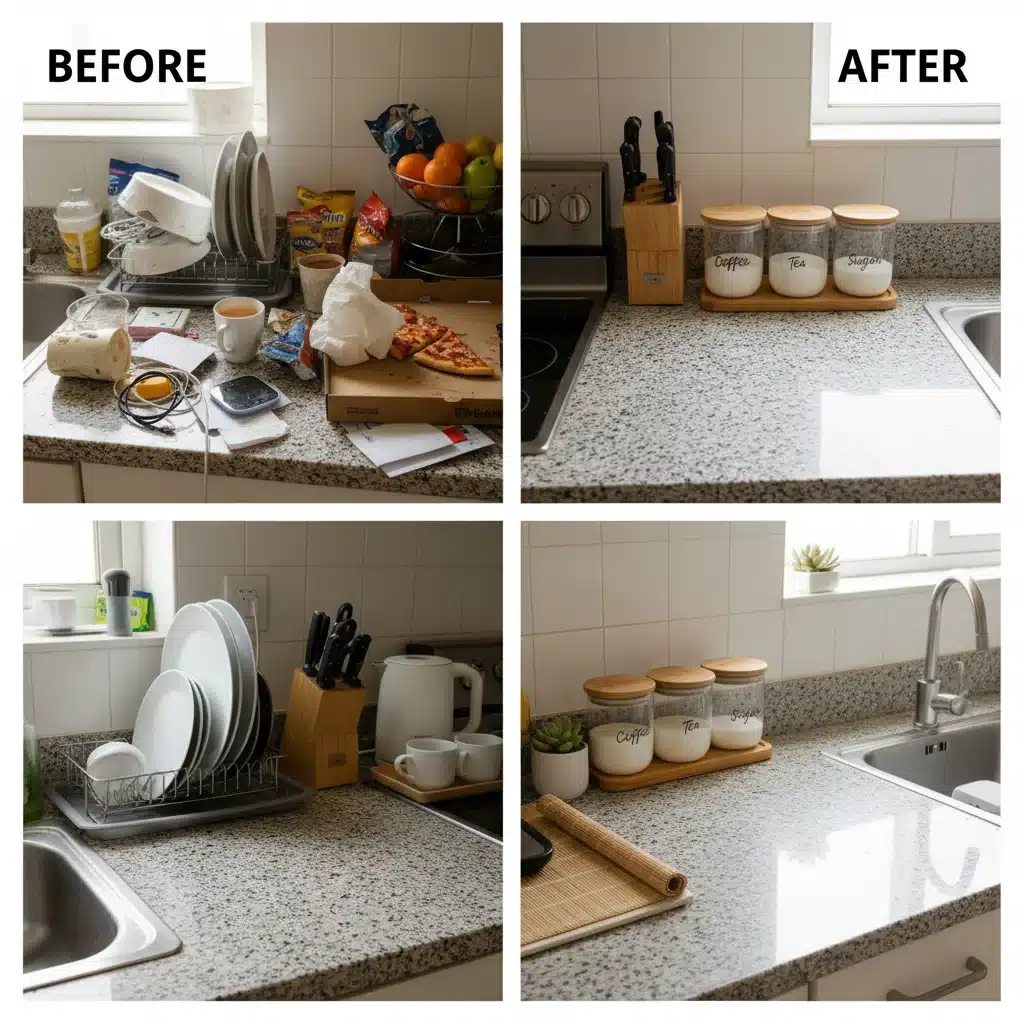
For example, if your kitchen counter is perpetually covered, dedicate your hour to clearing it. Remove all appliances you don’t use daily, put away dishes, and gather any miscellaneous papers or keys. The immediate visual impact of a clear counter can be incredibly motivating and is a testament to the power of focused home organization strategies.
2. Implement the ‘Four-Box Method’: A Systematic Approach to Sorting
Building on the power purge, the ‘Four-Box Method’ is a classic and highly effective technique among home organization strategies for systematically decluttering a larger area or an entire room. You’ll need four boxes (or laundry baskets, bags, etc.) labeled:
- Keep: Items you regularly use, love, and want to keep in your home.
- Donate/Sell: Items in good condition that you no longer need but someone else could use.
- Relocate: Items that belong in another room or part of the house.
- Trash: Items that are broken, expired, or truly useless.
Choose a room, and systematically go through every item. Pick up each item and immediately place it into one of the four boxes. Avoid overthinking; trust your gut reaction. The key here is to keep moving. Don’t stop to admire an old photo or read a book; just sort. Once all items in the room have been sorted into a box, deal with the boxes:
- Trash: Immediately take it out.
- Donate/Sell: Put it in your car or by the door to be dropped off as soon as possible.
- Relocate: Take these items to their rightful homes in other parts of the house.
- Keep: These are the items you will now find a proper home for within the room you are organizing.
This method prevents items from being shuffled around endlessly and forces decisions. It’s a structured way to process clutter, making it one of the most reliable home organization strategies for comprehensive decluttering. By dedicating focused time to each box, you ensure that the clutter is not just moved, but truly dealt with.
3. Vertical Storage Maximization: Utilizing Unused Space
When thinking about effective home organization strategies, many people overlook vertical space. Walls, backs of doors, and the height within cabinets and closets are often underutilized goldmines for storage. Maximizing vertical space can significantly increase your storage capacity without requiring additional floor space, which is especially valuable in smaller homes or apartments.
Consider installing floating shelves in areas like the kitchen, bathroom, or living room to store books, decorative items, or frequently used essentials. Over-the-door organizers are perfect for shoes, cleaning supplies, or pantry items. Stackable bins and drawer dividers can double or even triple the usable space inside cabinets and drawers. For closets, adjustable shelving systems, hanging organizers, and multi-tiered hangers can make a dramatic difference.
Think creatively about how you can go up. For example, in a pantry, instead of having half-empty shelves, use shelf risers or stackable containers to create multiple levels. In a home office, wall-mounted file holders or pegboards can keep important documents and supplies off your desk. This strategy not only helps in decluttering surfaces but also makes items more accessible and visible, reducing the time spent searching for things. Embracing vertical storage is a smart and often overlooked aspect of effective home organization strategies.
By strategically implementing vertical storage solutions, you not only create more space but also enhance the aesthetic appeal of your rooms by keeping surfaces clear and clutter-free. This approach is particularly effective for small items that tend to accumulate and create visual noise.
4. The ‘One In, One Out’ Rule: Preventing Future Clutter
Once you’ve decluttered and organized, the challenge becomes maintaining that order. The ‘One In, One Out’ rule is one of the most straightforward yet powerful home organization strategies for preventing new clutter from accumulating. The principle is simple: whenever you bring a new item into your home, an old, similar item must leave. This applies to clothing, books, kitchen gadgets, decor, and even toys.
For example, if you buy a new shirt, go through your wardrobe and donate or discard an old one. If you purchase a new novel, choose an old one to give away or sell. This rule forces you to regularly evaluate your possessions and prevents your home from becoming overstuffed. It encourages mindfulness about what you bring into your space and helps you maintain a curated collection of items that truly serve you.
Implementing this rule requires a slight shift in mindset, moving from accumulation to thoughtful acquisition. Over time, you’ll become more discerning about your purchases, knowing that each new item requires a sacrifice. This proactive strategy is crucial for long-term success in home organization and ensures your hard work in decluttering isn’t undone by new acquisitions. It’s a simple, sustainable habit that is a cornerstone of effective home organization strategies.
This rule is particularly impactful in areas prone to accumulation, like closets and craft supplies. By consistently applying the ‘One In, One Out’ rule, you establish a natural equilibrium, preventing the endless cycle of decluttering and re-cluttering.
5. Create ‘Homes’ for Everything: The Foundation of Lasting Order
One of the biggest reasons homes become cluttered is that items lack a designated ‘home.’ When an item doesn’t have a specific place to belong, it ends up sitting on counters, tables, or floors, creating visual noise and making it difficult to find things when you need them. Establishing a ‘home’ for every single item is a fundamental principle of effective home organization strategies.
Go through your most frequently used items and designate a specific spot for them. For example, keys should always go on a hook by the door. Remote controls should have a specific tray or caddy on the coffee table. Mail should go into an inbox or a designated sorting area immediately upon entering the house. Cleaning supplies should be kept together under the sink or in a specific cabinet.
This strategy requires a bit of upfront thought and possibly some investment in storage solutions like bins, trays, hooks, or drawer organizers. However, the time saved searching for lost items and the peace of mind from knowing where everything belongs is invaluable. Once everything has a home, the act of tidying up becomes a simple matter of returning items to their designated spots, rather than a puzzle of where to put things. This makes daily maintenance much easier and more sustainable, solidifying its place among top home organization strategies.
Ensure these ‘homes’ are logical and convenient. Items used together should be stored together. Items used frequently should be easily accessible. The easier it is to put something away, the more likely you are to do it, making your organizational efforts truly stick.
6. The ‘Daily 15-Minute Tidy-Up’: Sustaining Your Organized Space
After implementing the initial decluttering and organizing home organization strategies, the final, crucial step is to establish a routine for maintenance. The ‘Daily 15-Minute Tidy-Up’ is a simple yet incredibly powerful habit that prevents clutter from creeping back and keeps your home consistently organized. This isn’t about deep cleaning; it’s about resetting your space at the end of each day.
Set a timer for 15 minutes each evening (or morning, whatever works best for your schedule) and focus solely on putting things back in their designated ‘homes.’ This might involve:
- Putting away dishes or loading the dishwasher.
- Folding blankets and fluffing pillows in the living room.
- Gathering any stray items and returning them to their respective rooms.
- Wiping down kitchen counters.
- Straightening up your workspace.
The beauty of the 15-minute tidy-up is its brevity and consistency. It’s a small commitment that yields significant results over time. By addressing minor clutter daily, you prevent it from snowballing into an overwhelming task. This routine reinforces the ‘homes for everything’ principle and keeps your efforts from being undone. It’s a proactive approach to maintaining order and one of the most vital home organization strategies for long-term success.
Think of it as brushing your teeth for your home – a small daily habit that prevents bigger problems down the line. This consistent effort ensures that your home remains a sanctuary, not a source of stress, proving that daily, small actions are key to enduring home organization strategies.
Beyond the Strategies: Cultivating an Organized Mindset
While these six home organization strategies provide a robust framework for decluttering and maintaining order, true mastery of home organization extends beyond mere techniques. It involves cultivating an organized mindset – a shift in how you view your possessions and your living space. This mindset encourages intentionality, mindfulness, and a proactive approach to managing your environment.
Embrace Minimalism (to a degree)
You don’t have to become a minimalist guru, but adopting some minimalist principles can significantly enhance your home organization strategies. This means questioning the necessity of every item you bring into your home and appreciating the value of open, uncluttered spaces. Ask yourself: Does this item truly add value to my life, or is it just taking up space? The less you have, the less you need to organize.
Regular Review and Adjustment
Organization is not a one-time event; it’s an ongoing process. Regularly review your systems and adjust them as your needs and lifestyle change. What worked last year might not work today. Be flexible and willing to tweak your home organization strategies. For instance, if a particular storage solution isn’t working, don’t hesitate to try something new. Seasonal decluttering, where you go through your belongings once or twice a year, can also help maintain order and ensure your systems are still effective.
Involve the Household
For sustainable home organization strategies, everyone in the household needs to be on board. Educate family members about the ‘homes’ for items and the ‘one in, one out’ rule. Encourage participation in the daily tidy-up. When everyone contributes, the burden is shared, and the results are more lasting. Children, even young ones, can learn to put away their toys and clothes, fostering good habits from an early age.
Celebrate Small Victories
The journey to an organized home can feel daunting. Celebrate every small victory – a cleared counter, an organized drawer, a successfully maintained daily tidy-up. Acknowledging your progress keeps you motivated and reinforces the positive impact of your home organization strategies. This positive reinforcement is crucial for maintaining momentum and preventing burnout.
Understand the ‘Why’
Finally, always remember why you’re organizing. Is it for peace of mind, reduced stress, more time, or a more functional living space? Keeping your ‘why’ at the forefront will provide the motivation needed to stick with your home organization strategies, even when you feel overwhelmed. An organized home is not just about aesthetics; it’s about creating a better quality of life.
Conclusion: Your Path to a Serene, Organized Home
Achieving an organized home might seem like an endless battle, but with the right home organization strategies, it’s an attainable goal that can be significantly advanced in just a few hours. By implementing the ‘One-Hour Power Purge,’ the ‘Four-Box Method,’ maximizing vertical storage, adopting the ‘One In, One Out’ rule, creating ‘homes’ for everything, and committing to a ‘Daily 15-Minute Tidy-Up,’ you lay a strong foundation for a consistently clean and functional living space.
Remember, organization is a journey, not a destination. It requires consistent effort, mindfulness, and a willingness to adapt. But the benefits – reduced stress, increased productivity, a more welcoming environment, and a greater sense of control – are immeasurable. Start small, be consistent, and celebrate your progress. Embrace these practical home organization strategies, and you’ll soon discover the profound peace and efficiency that come with a truly organized home. Take the first step today, and transform your living space into the sanctuary you deserve.